Category: Theatre Reviews

  • Review: The Last Man & With All My Fondest Love

    The Main Takeaway: If one has a one-person show, one would be well-advised to hire someone who can act. Better still, one would be well-advised to hire someone who can write.

    The Last Man

    Tl; dr: With a different writer, director, composer, and actor, this might have been rather good show.

    Let us begin with the good bits. 

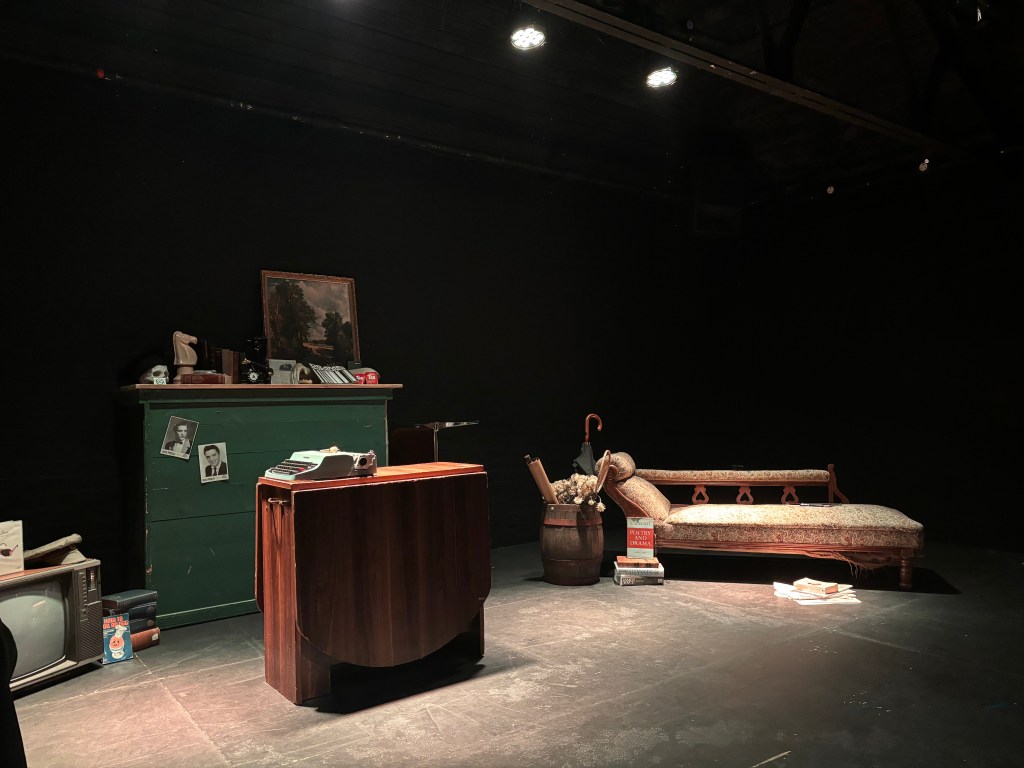
    The set was genuinely excellent. The packaging boxes were a classic device deployed intelligently: their water damage in Act Two elegantly conveyed the decay of the protagonist’s mental and physical world, and the cardboard-box bed nicely reminded one of Paris Olympics 2024. I took several photographs before the show began in admiration.

    The lighting, too, deserved better company: sleek LED strips that lent the space a cool, modern aesthetic.  

    Above all, the central idea had real promise. The play seemed to be playing, with some subtlety, with the idea of the unreliable narrator. In the end, when the protagonist’s mother, landlord, and tutor all came banging on the bunker door with zombie moans in the background, one began wondering (in a rather Sartrean fashion): was the hell a literal zombie apocalypse, or merely other people in a modern society? The open ending was a genuinely clever idea that could have led to two distinct interpretations of everything that had gone before – I suspect that was why it was a ‘cult favourite’ in Korea. 

    Alas, a promising idea is nothing in itself – one is reminded that a Labour government was a very promising idea just a year ago. 

    For the ambiguity to land, the writer needed to scatter breadcrumbs far earlier and far more deliberately. In fairness, certain details – the teddy bear’s inexplicable teleportation, the radio’s wavering between Morse code and human speech, etc – were presumably intended as exactly such breadcrumbs – yet they were so flatly delivered that they flew over the audience’s heads. The writer, however, remained the primary culprit. The narrative collapsed – if I may be forgiven for saying so – like Syngman Rhee’s army before Kim Il Sung – and there was, alas, no General MacArthur landing at Incheon to save the day. For the majority of two hours, the script preoccupied itself with explaining elementary Korean vocabulary and folk wisdom to what seemed to be an imaginary ignorant European audience and enthusing over common Korean snacks with the energy of a sponsored YouTube video. This is, at best, a failure of craft; at worst, a kind of inadvertent self-exoticisation.

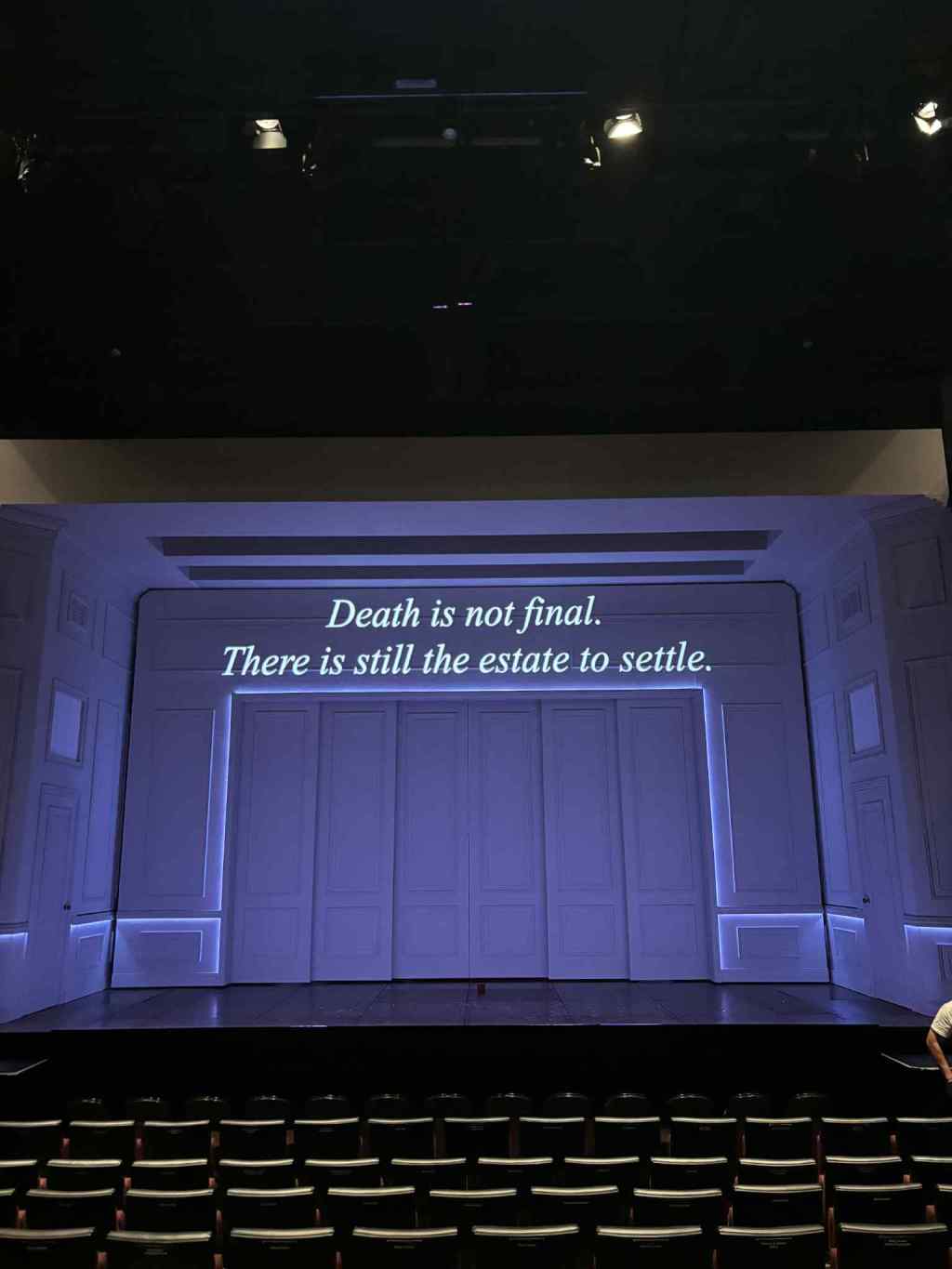
    On this note, the best agents for ‘culture’ in my humble opinion, are never parcels of ‘exotic words’ or recuring tropes but concrete stories and convincing characters. The Estate at the National Theatre demonstrated this beautifully: the trick is to make your characters human first, and allow everything else – nationality, background, and what-have-you – to follow. Starting from the premise that one wishes to represent a culture is always perilous because it almost always leads to characters assembled from stereotypical cultural signifiers. As this production so vividly demonstrated, Shin ramen tubs and mukbang streams are not good characterisation. Consequently, for 90% of the running time, I was oscillating between bafflement, boredom, and mild offence – until the promising idea revealed in the final moments presented a twist just interesting enough to remind me what the preceding two hours might have been. Alas, too little, too late.

    The composer managed to make a bad situation worse. This was, to speak plainly, among the blandest musical scores I have encountered. Operation Mincemeat – previously my least favourite musical ever– at least had the virtue of variety. All but one song (the teddy bear one, which had some unique tenderness to it) were melodically indistinguishable and entirely unmemorable. An AI-generated musical I encountered online some months ago made a more interesting listen.

    The performer, likewise, presented great difficulties. Nabi Brown is, according to her profile, a recent graduate of Trinity Laban, yet her performance in The Last Man suggested something rather earlier in the educational pipeline and invited uncomfortable questions about what exactly goes on inside this country’s conservatoires. The opening number was clearly off-pitch, and things did not substantially improve over the next two hours. The high notes were more often shouted than sung. More damaging still, the acting was consistently superficial: a great deal of movement for movement’s sake, and emotional expression that felt closer to imitation than inhabitation. The stakes, which should have been enormous (whether one accepts the zombie apocalypse or the domestic reading), were simply absent. A more experienced performer might have smuggled a measure of genuine complexity into the script, and salvaged something from its better impulses. As it stood, the immaturity of the writing and the performance simply amplified one another. Nerves on a particular night, perhaps, accounted for some of it. But one could not help but think that Brown may ultimately have been the victim of her good fortune – a solo musical with a *challenging* script is perhaps too great a challenge for anyone fresh out of conservatoire. 

    With All My Fondest Love

    Tl;dr: The writer/actor should have deleted this from his notes app back in his second year.

    Oh boy, oh boy, oh boy… 

    This was, to speak plainly, a dysentry of words performed by a man who somehow managed to seem constantly constipated. 

    I confess I would not have reviewed this piece at all had The Last Man not given me something with which to compare it – for the comparison alone made the exercise feel worthwhile. Both are one-person shows suffering, fundamentally, from the absence of a compelling performer. But The Last Man had at least one idea worth excavating, whilst With All My Fondest Love had neither idea nor the promise to develop one. I remember leaving the theatre with a strange sense of relief, thinking that perhaps humanity has found in Noah Wild the last line of defence against AI replacement – for no AI could have hallucinated out a piece of text so weird, meaningless, structureless, and utterly intellectually sterile. 

    The conceit itself was perfectly serviceable: an alternation between the correspondence of Wild’s grandparents, Harold and Marlene, and Wild’s own romantic tribulations at university. Fine. The difficulty was that Wild appeared constitutionally unable to do anything interesting with either element by reflecting on his experiences and/or processing his emotions. His exploration of Harold and Marlene extended no further than reading their letters aloud in a variety of tones; and his reflections on his own romantic life reached no greater depth than something like: ‘I know there are many reasons to dislike me. I know I am not a ten. But I am at least a six.’

    The result was a piece of writing that was deeply weird – somehow simultaneously soulless and emotionally overwrought – a combination that is technically quite difficult to achieve, yet Wild appeared to accomplish without effort. The comparison of his grandparents’ loss of a child with his own heartbreak at being left by a university partner felt, at best, a bit careless. The immediate pivot from his grandfather’s service in the British imperial army during Partition – with its imagery of real and terrible brutality vividly described to the audience – to a photograph of his grandmother sunbathing topless was actively insensitive. And the juxtaposition of his grandmother’s extramarital affair with his girlfriend leaving him to focus on her own career (what Wild described rather diminutively as ‘fancy internships’) was a gross failure of proportion. If one is to be less charitable, one might suggest that it all felt like Wild publicly used the *very* private correspondence of his late grandparents as his consolation tissue after a fairly conventional separation. 

    The specifically gendered texture of Wild’s self-pity was also, to put it gently, a liability. Lines which went something like: ‘You said you needed space — I’ll give you space. But don’t fucking block me’ or ‘I know you need space, but fuck it, I miss you, I love being loved by you’ sounded less like expressions of romantic anguish than posts in a manosphere forum by someone whom the Gen-Z would label ‘incel’. 

    There were also a myriad of minor issues with craft. Details such as Harold’s collection of women’s clothing or an aside about his own excessive chest hair were dropped so abruptly and without narrative purpose that they managed to be simultaneously conspicuous and entirely inert, disrupting the rhythm of scenes they added nothing to. But these can wait, in light of all the aforementioned problems. 

    On the performance, which was almost as bad as the writing, there is not a great deal one can say beyond four observations: 

    1. Fake crying on stage is never a good idea.
    2. Speaking faster and louder whilst standing on a box is not, in itself, emotional intensity.
    3. If your own photographer is asleep in the front row with several other audience members you should probably reflect.
    4. Please seriously consider another career. 

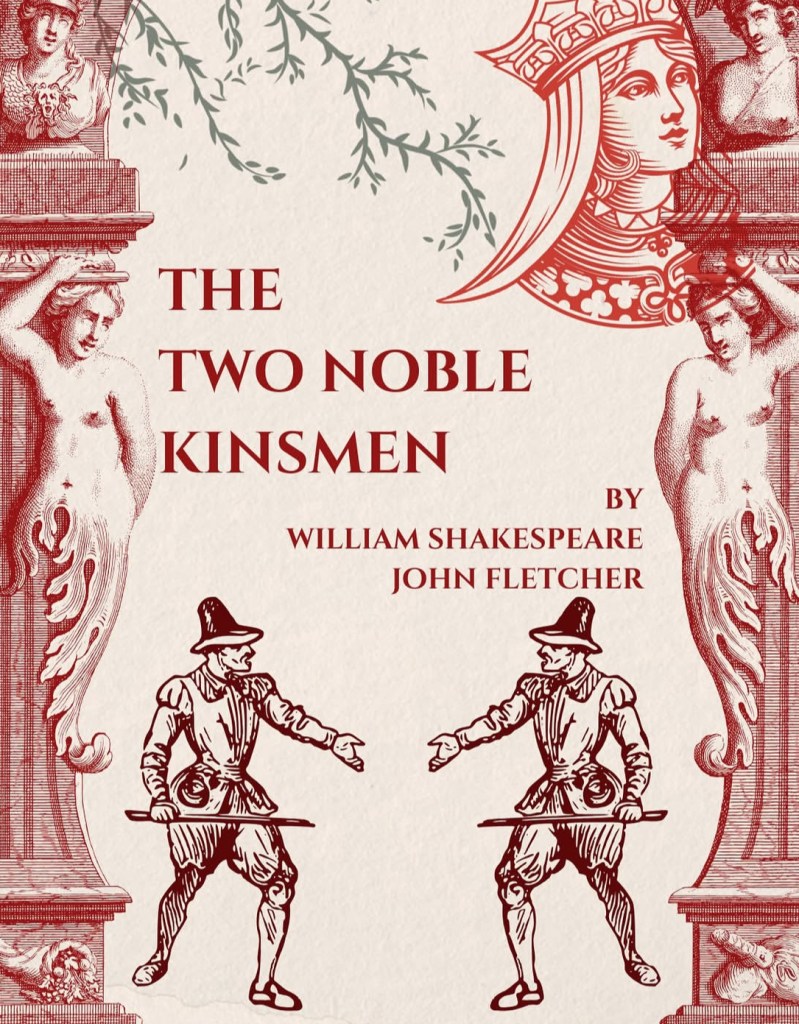
  • Two Noble Kinsmen in Mansfield Principal’s Garden Reviewed by a Guest Pigeon

    Star rating: N/A (The Guest Pigeon who writes in Baskerville opted out of the numerical grading system)

    In the hands of director Annabelle Higgins, Fletcher’s and Shakespeare’s The Two Noble Kinsmen, based on Chaucer’s Knight’s Tale, reaches its tragicomic potential and provides welcome refreshment amongst the innumerable productions of A Midsummer Night’s Dream and The Importance of Being Earnest which are wont to grace the gardens of Oxford’s colleges.

    Although the performance takes place as Trinity Term has just started, the weather is sunny and the production well-organised. As I arrive at my seat, adorned with Morris dancers’ bells, Hannah Wei creates a merry atmosphere as a number of old tunes skip forth from her penny whistle. It is clear that Higgins’ taste is classical even before the appearance of wine-skins, swords, and leather armour, though her edition mercilessly breaks the iambic pentameter with great frequency.

    The play opens with a pastoral chorus set to music by Owen Robinson, elegantly conducted by Phoenix Solti. It is the first time we hear the mellifluous voice and eminent musicality of Paloma Díaz as the Jailer’s Daughter, whose continual singing can be relied upon to distil her increasing madness into moving moments of emotional clarity. We are soon introduced to the titular characters. One is a charmingly boyish Palamon, played in a North-American accent by Ryan Silien, the other an initially bemusing Arcite, played by Josephine Haarhoff-Nargi, whose variously contorted face and almost Victorian style of delivery, featuring frequent elision and a hexa-syllabic i-ma-gi-na-ti-on, provides expressive clarity and elicits considerable nostalgia. Silien fully embodies the drama with a disarming artlessness, the superficiality of which, though slightly camp, gives an impression of youthful energy rather than of poor technique. Haarhoff-Nargi’s Arcite is more calculated and observing (though no less camp), and more acerbic in his jibes than furious. The dynamic between the two is one of a sprightly hilarity, contrasting with the greater emotional maturity of the sisters-in-law Emilia and Hippolyta. Imogen Green’s Emilia has too strong a moral compass for womanhood and thus stays ever maidenly, supremely innocuous though not quite innocent. Her tears flow for her own unfortunate position as the object of the kinsmen’s double affection and for the cruelty of the world. Rowena Sears as Hippolyta emerges as the most likely candidate for an acting career: her unparallelled instinct for Jacobean text, unrelenting Meisnerian focus, absolute truth of word and action, striking, faintly pre-Raphaelite appearance (with flowing red hair), and natural nobility of movement and posture make her mesmerising to watch even as she stands observing the action. More magical than brawny, her dread Amazonian has the appeal of a fairy queen.

    The interval coincides with twilight, and the air bites shrewdly. Cast and audience shiver. Higgins exhorts us to brave the cold. The stakes are raised; dilly-dallying will no longer be tolerated. A sense of urgency and foreboding as Phoenix Solti’s lighting enchants the stage. Díaz’ Jailer’s Daughter is lost in the forest, dancing and sprinting to keep her heart and body warm. She joins Lily Zhang’s Schoolmaster and her pupils in a Morris, expertly accompanied on the melodeon by a radiant Saul Bailey. Green’s Emilia is desperate to enjoy herself; Sears’ Hippolyta looks prepared to slay the whole company. We laugh at Emilia as she gazes at Arcite’s and Palamon’s ill-fashioned portraits; she joins in our laughter, aware of the absurdity of her plight, but tears prick behind.

    Tragedy finally arrives in the fifth and final act. Three prayers. Faint humming. We feel the presence of Chaucer. Haarhoff-Nargi’s classical sensibility no longer seems eccentric; her approach is not only correct but necessary for Arcite’s prayer to Mars. Arcite himself best describes his struggle:

    I am in labour

    To push your name, your ancient love, our kindred

    Out of my memory, and i’ th’ selfsame place

    To seat something I would confound.

    Tears stream down Haarhoff-Nargi’s cheeks. The struggle is cosmic. Mars turns green Neptune and the stage into purple; the vastness of his divine power shakes Arcite so deeply that the blood of the fallen seems to contaminate the planet as well as the sea. Haarhoff-Nargi proves herself a timeless vessel for the heaviest lines of the play:

    O great corrector of enormous times,

    Shaker of o’er-rank states, thou grand decider

    Of dusty and old titles, that heal’st with blood

    The Earth when it is sick, and cur’st the world

    O’ th’ pleurisy of people, I do take

    Thy signs auspiciously, and in thy name

    To my design march boldly.

    The contrast between the accents and attitudes of Arcite and Palamon, which not long ago produced much amusement, now becomes fateful. Arcite in addressing Mars became a giant; for Venus kneels a tiny Palamon. Silien’s prayer sweetly flutters about, his eyes glistening with hopeful youth:

    Hail, sovereign queen of secrets, who hast power

    To call the fiercest tyrant from his rage

    And weep unto a girl; that hast the might

    E’en with an eye-glance to choke Mars’s drum

    And turn th’ alarm to whispers.

    Arcite bows to death, Palamon to life, and Emilia to virtue. The spirit of Iphigenia seems to reside in Green as she stands shivering and weeping at Diana’s altar, decked in white, one with the silver hind in her hands. Arcite wins the duel but dies shortly afterwards in the embrace of his beloved Palamon and Emilia. No fake blood, no affected sighs and groans, only love and a request for forgiveness and a last kiss.

    The beauty of tragicomedy is rightly celebrated with a closing Morris. We clap and thaw.

    (Hertford & Mansfield Garden Play, 9 May 2026)

  • To What End: an English student’s commendable attempt at French absurdism 

    To What End: an English student’s commendable attempt at French absurdism 

    2.5-3/5

    I do not know whether there is anything peculiarly exciting in the air of this particular part of Oxfordshire, but the number of theatrical suicides that take place seems to me considerably above the proper average that statistics have laid down for our guidance.’

    I confess I have not written reviews in some time — life got in the way (as it tends to do), and the few productions I managed to see (with the exception of a musical) proved less thought-provoking than my company law textbook, rendering review-writing an utterly futile exercise. This somewhat harsh review comes not from a place of contempt — quite the opposite, in fact. This is the first time in months that I feel positively compelled to write a review, for To What End was considerably more stimulating than most new writings I had seen in London. The severity in the paragraphs to come stems rather from a peculiar form of self-reflection (which some may call self-hatred): when one sees in another’s work some fault which reminds one of the many issues in one’s own writing, a certain harshness (which is sometimes excessive) creeps in, born of that particular ruthlessness we reserve for our own failings, which prompts one to go a bit overboard in one’s criticism. My empathy, therefore, may prove a curse for this review. 

    I must begin by praising the play’s ambition. Indeed, the title itself reflects the writers’ literary (if not philosophical) aspirations, and the writing shows genuine intellectual edge — a quality rare enough in much of contemporary theatre, rarer still in student writing. The structure played with repetition and circularity, and with each cycle the play became more ‘meta’, as the characters were wont to say, compelling the audience to muse on relationships between the writer and the director, the performer and the observer, etc etc. On the whole, the writing had an elusive but roguish charm which flirted with French absurdism, whilst the lines were peppered with English wit — an ambitious (albeit dangerous) Anglo-French hybrid. 

    Curiously, however, I was under the impression that the play was split in two halves by a death like Camus’ The Stranger (I thought that was where ‘Albert’ came from). Up until the first murder-suicide, there was careful character development: a pair of actors with evident personal history played a wartime German-English couple; at the same time, we caught glimpses of complex feelings between the two directors, Bernard and Albert. The dialogue sparkled with wit, and the characters were gradually gaining weight (figuratively, of course). With the first murder-suicide, however, everything fell apart — for the characters and the play alike. The directors became actors, the actors became directors, and a trial scene unfolded where the director and the judge repeated lines in an endless loop. Before the first murder-suicide, the dialogues had subtle grace and felt like a riddle leading somewhere. Afterwards, when everything began to spiral, the lines crumbled under the weight of the ‘meta’ absurdism the writers wished to convey. What began as measured absurdism devolved into something that felt like circularity for circularity’s sake — almost like a bad English parody of French absurdist theatre.

    I would venture that the crux of the issue is that in absurdist theatre, whilst the text can be meaningless, characters cannot be aimless. 

    In the production I watched, I often couldn’t distinguish between performance and reality — which, admittedly, was conceptually very clever, but when one really could not tell whether someone was pretending to be a second-rate actor, the conceptual cleverness of the writing inevitably fell flat on an audience too confused to appreciate the philosophical nuance. Peregrine Neger, who was playing Albert, almost succeeded in conveying all the layers of (un)reality and doing justice to the writers’ ambitions. Sadly, the burden proved too heavy for a single set of shoulders. In particular, Bernard, played by Tomasz Hearfield, was in such a consistent state of nicotine-fuelled anxious confusion which transcended, and therefore defeated, all attempts at layering realities. Perhaps in an ideal world where there were more chemistry between Albert and Bernard, there would have been less confusing absurdity and more genuine absurdism. But it wasn’t just Bernard. I dare say that beyond Albert (and perhaps The Tape), most characters lacked a consistent aim. The Husband and Wife were like a pair of colourful cutouts, whilst the judge and the detectives were like grey shadows lurking in the corner, but their insularity and one-dimensionality were not quite by design. Often, therefore, Albert appeared stranded whilst Bernard wandered off and other characters mushroomed around them. In the absence of effective interactions, the tensions that had built up in the first part inevitably deflated. Even Albert occasionally lost his edge, becoming something like a stock art critic character. For the play as a whole, the consequence is that the outbursts often felt abrupt and groundless, leaving the suicides that followed in an uncomfortable middle ground — too light to warrant emotional responses but too heavy to achieve absurdity. In the end, the yield of the above-average theatrical suicide count was sadly below-average. I could not even ascertain whether it was a comedy or a tragedy — and not quite in a meta way. 

    Fundamentally, that was a writing problem rather than an acting one. The characters beyond Albert and Bernard had limited material to work with. Not that they had no stage time, but that their lines often felt like fillers without much potential for character-building or dramatic tension, and it wasn’t clear what individual characters were trying to achieve during their time on stage. I posit this was because the writers did not know exactly why they were asking ‘to what end’ in the first place. What exactly prompted the inquiry? Why are quests for meaning futile? What answers have been given and why were they all inadequate? In the absence of answers to these questions, the absurdism lacked substance, and the lack of a philosophical dimension translated into minimal depth for most minor characters.  The interview and the court scenes, for instance, felt a bit pointless — not in the productive, absurdist sense, but in the deflating sense that one suspects the writers simply didn’t know what to do with them. It seemed like the minor characters existed solely to serve Bernard and Albert, who were, for reasons stated above, often none the wiser. 

    To be sure, characters can of course question ‘to what end’ their existence serves, but a character that does (or worse, is) little else rarely sways an audience. Personally, there are two things I learnt the hard way and am still grappling with. Firstly, characters audiences care about are usually built from intentions rather than historical facts (or, worse, philosophical ambitions). Secondly, audiences dislike being addressed through obscure symbolisms that exist purely for the writer’s satisfaction. An outstanding actor might be able to hide or compensate for such problems by inventing intentions within the constraints they are given, essentially completing the character work and elevating the play. However, that is an enormous ask of student actors working with limited rehearsal time and still developing their craft. 

    Similarly, plays can pose very meta questions about meanings or purposes, as indeed many French absurdist plays have done. However, to be properly French, one must first master the art of French essay-writing to some extent: the age-old framework of thesis-antithesis-synthesis may seem rigid and archaic, but it remains instructive. Absurdism and metatheatricality without dialectical progress deprive a play of actions and make philosophical musings seem like a whole lot of hot air. Arguably, to reach genuine absurdity, one must either begin with something concrete and watch it inevitably collapse under the weight of existential conditions like Ionesco, or imbue every element with absurdity and dive into more layers as the play progresses, like Beckett. Whilst I do not profess to be the expert on absurdism and there are certainly exceptions to the general rule, I dare say that hitting the audience square in the face with circularity without dialectical progression and expecting the audience to immediately grasp the writer’s genius is asking for a bit too much. In short, taking a sledgehammer to ‘meaning’ without establishing what that meaning might be risks missing the point of iconoclasm — one may end up with absurdity without absurdism. It brings to mind the humanities undergraduate encountering Derrida far too early in their career and embraces deconstruction before learning to be constructive. 

    Fortunately, character-building and philosophical exploration work best in tandem, and the writers have already laid very solid groundwork. Their intelligence is evident throughout. I dare suggest two adjustments that may help do their ambition justice. First, grounding abstract ideas in concrete character motivations. Albert and Bernard are already well-written characters possessing genuine charm, distinct personalities, and interpersonal chemistry. A bit more clarity on Bernard’s writerly angst would help considerably with landing the absurdism. To this end, the writers might consider channelling more of their own philosophical frustrations about meanings in theatre. And if each minor character can be given a clearer philosophical as well as personal purpose, the spirals may clear up a great deal. Secondly, be careful with repetitions. As someone often guilty of wanton repetition, repetitions seldom work as well on stage as they do in the writer’s imagination. Better to let characters speak as characters rather than anchoring the play on repetitions — not that repetitions never work, but indulging in repetitions can spoil a play. Admittedly, however, it is much easier to talk the talk than walk the walk. Abstract ideas are clean and elegant, whilst human intention is like a lamprey — slippery, slimy, and altogether disgusting to handle. 

    Despite all these quibbles, I enjoyed the production. I had a good laugh, loved the ideas behind it, left the theatre thinking about it, and did not stop thinking about it till 3am the next morning. The writers may have bitten off slightly more than they could chew, but that’s hardly a sin. Better to aim for the moon and land among the treetops than never leaving the ground at all.

  • The Estate: a Surgical Debut

    The Estate: a Surgical Debut

    5/5

    To be entirely honest, I bought a ticket to this show1 on a whim. I was idly browsing the NT website after realising that the show I have been meaning to go to has sold out, and when I saw the word ‘scandal’ next to the figure ‘£20’, I thought ‘why not’. 

    I went into the Dorfman Theatre with rather moderate expectations, partly because a rather awful show I watched way back had somewhat tainted the venue for me by association, but more so because I was not expecting too much from a play tagged with both politics and identity. By experience, from political plays one could expect a few archetypal characters mixed into a rather flat base of chronological narrative, inoffensively spiced up with conflicts along familiar partisan faultlines, and topped off with a dash of dry wit —- much like a single G&T on a weekday evening. Works exploring cultural identities, meanwhile, are often a bit hit or miss —- if a writer (or director, or producer, etc) deliberately panders to a (real or imagined) ‘diverse’ audience, they run the risk of turning a good story into a sad assemblage of shallow archetypes and hollow cultural symbols in pursuit of ‘relatability’. 

    I left the Dorfman with my mind blown. The only thing I could say over the next half an hour or so was ‘wow’. I really cannot think of a better play out of the countless ones I have seen in London over the past few years, and it would not be an exaggeration to say that this play has single-handedly reset my expectations of plays dealing with politics and/or identity.

    With impeccable (some may say almost surgical2) precision, The writer (Shaan Sahota) has delivered every bit of what one may expect from a good political play in the first twenty minutes of The Estate. The opening was packed with information without being overly expositionary: the (real and wannabe) politicians’ tongue-in-cheek way of tiptoeing around a sex scandal immediately gripped the audience because it was oh-so-painfully accurate. And the words uttered were marvellously complemented by those that were not. The (rather unfortunate) fact that over 50% of communication is nonverbal is perfectly captured in the characters’ interactions with one another. The power play between Angad (Adeel Akhtar), the protagonist and contestant for party leadership, and Ralph (Humphrey Ker), the party whip, was delivered in hmphs, pauses, tiny interruptions, and glances at smartphones. The slights were subtle, yet effectively delivered everyone who has been on the receiving end a painful sting. This, sprinkled with some wit reminiscent of the BBC classic Yes, Prime Minister when the cynical career politicians snubbed the naive idealism of Isaac (Fode Simbo), the access scheme intern, made the first half an absolute delight. 

    Even more painfully accurate was Sahota’s satirisation of Oxonians. In the programme, every Oxonian character had their college affiliation exposed —— a charming detail which I found very amusing —— and the characterisations were both specific to their respective colleges and scarily accurate. Ralph was essentially a generation of older Mertonians wrapped in a trenchcoat, and whilst the text itself never stated which exact college Sangeeta (Dinita Gohil), Angad’s wife, attended, her mannerisms somehow oozed Jesus College. And it was not just their college affiliations: Sahota even managed to convey which boarding school her characters had attended before university. Petra (Helena Wilson), for instance, was a spot-on archetype of an professionally-ambitious girl from an academically-focused all-girls boarding school, providing a lovely contrast with the rather more genteel and domestic Sangeeta.  I felt like I had heard so many of those conversations somewhere in Oxford, and I have been selling this play to my friends as a ‘wonderfully (woefully?) accurate ethnographic (zoological?) study of Oxonians in their natural habitat’. All of these convinced me that the writer must have been an incredibly observant Oxonian who lived and breathed that bizarre bubble. 

    But this was way more than just a good political play. In parallel with the politics, the play developed a wonderfully-poignant storyline focusing on Angad’s rather awful father and the messy family drama he had left behind. Outside of the office and the leadership contest, Angad was a son with unresolved father issues and a little brother spoiled by his sexist and authoritarian father and two long-suffering sisters —- Gyan (Thusitha Jayasundera), a mother-like oldest sister who repressed her inner longings to mother her siblings, and Malicka (Shelley Conn), a rebellious second sister who flees the family, ironically via marriage. Sahota carefully dissected and psychoanalysed this canonical and almost cliché family configuration to give a painfully accurate depiction of the conflicts, dynamics and traumas rather common amongst South Asian immigrant families3. This made the entire world of politics seem rather small (which, one might say, is rather apt given the current state of politics). Moreover, Sahota’s portrayal of family was anything but soppy. Angad told his constituency that his father came from nothing, ran a humble local business, and offered new immigrants mango and chai —- but in reality he was an emotionally- and physically abusive man who had a portfolio of slum-like, legally-questionable properties which he rented out to new immigrants so he could send his son to Harrow. Likewise, Angad and his sisters talked about familial affections and swore that ‘it is not about money’ but it was oh-so clear that everything was measured in sums, whilst Sangeeta maintained her splendid isolation behind her father’s money. Having seen too many ‘hearth and home’ eulogy, the depiction of middle-class immigrant families in The Estate was wonderfully refreshing. And precisely because Sahota did not shy away from the ugly realities of family and culture, the rare moments of affection came across as particularly realistic. 

    I spent the entire interval anxiously devouring a tiny tub of vanilla ice cream, fearing a ‘drop’ in Act 2 because I was not sure how those various strands could be effectively woven together. Act 2, however, not only laid my worries to rest but also went way above and beyond my expectation. Plot-wise, it was rather foreseeable that Angad’s private troubles would bleed into his public life, yet what happened after the blow-up absolutely took me by surprise. Without spoiling too much, what seemed and felt like a political death sentence was overturned by Angad’s cynical-yet-ingenious ad lib on ‘our tradition’ and ‘multiculturalism’ at the party conference. Meanwhile, on the family front, instead of resolution, there is the beginning of another cycle. Everything was turned upside down yet nothing had changed. Power changed hands, but the new leader came from the same exact crop as the old, and politics was still hollow, hollow, hollow. Likewise, generational trauma survived the implosion of a family, and no one really came to terms with culture or migrant identity because, frankly, no one cared. The story thus got a perfect ending but no character received closure, leaving the audience simultaneously satisfied and wanting more. 

    I drafted this review on a euphoric adrenaline rush on my way back. It was truly one of the best productions I had seen in a long time, and I struggled to find a single weak link. The directing and acting brought out the best of the writing, and the stage, sound, and light designs were all phenomenal. Moreover, Sahota absolutely deserved every bit of her National Theatre debut, and I truly believe that we are witnessing a rising star that, given time, could well become one of the best British playwrights of this generation. 

    1. The Estate is a new play by Shaan Sahota, at the Dorfman Theatre of the National Theatre until 23 August 2025. ↩︎
    2. The word is carefully chosen given that the playwright is also a junior doctor, and it was interesting to see elements of her experience working in healthcare throughout the play. ↩︎
    3. Though I can really only speak for East Asian ones. ↩︎
  • The Final Salomé, “Il ne faut regarder que l’amour”

    The Final Salomé, “Il ne faut regarder que l’amour”

    3-3.5/5

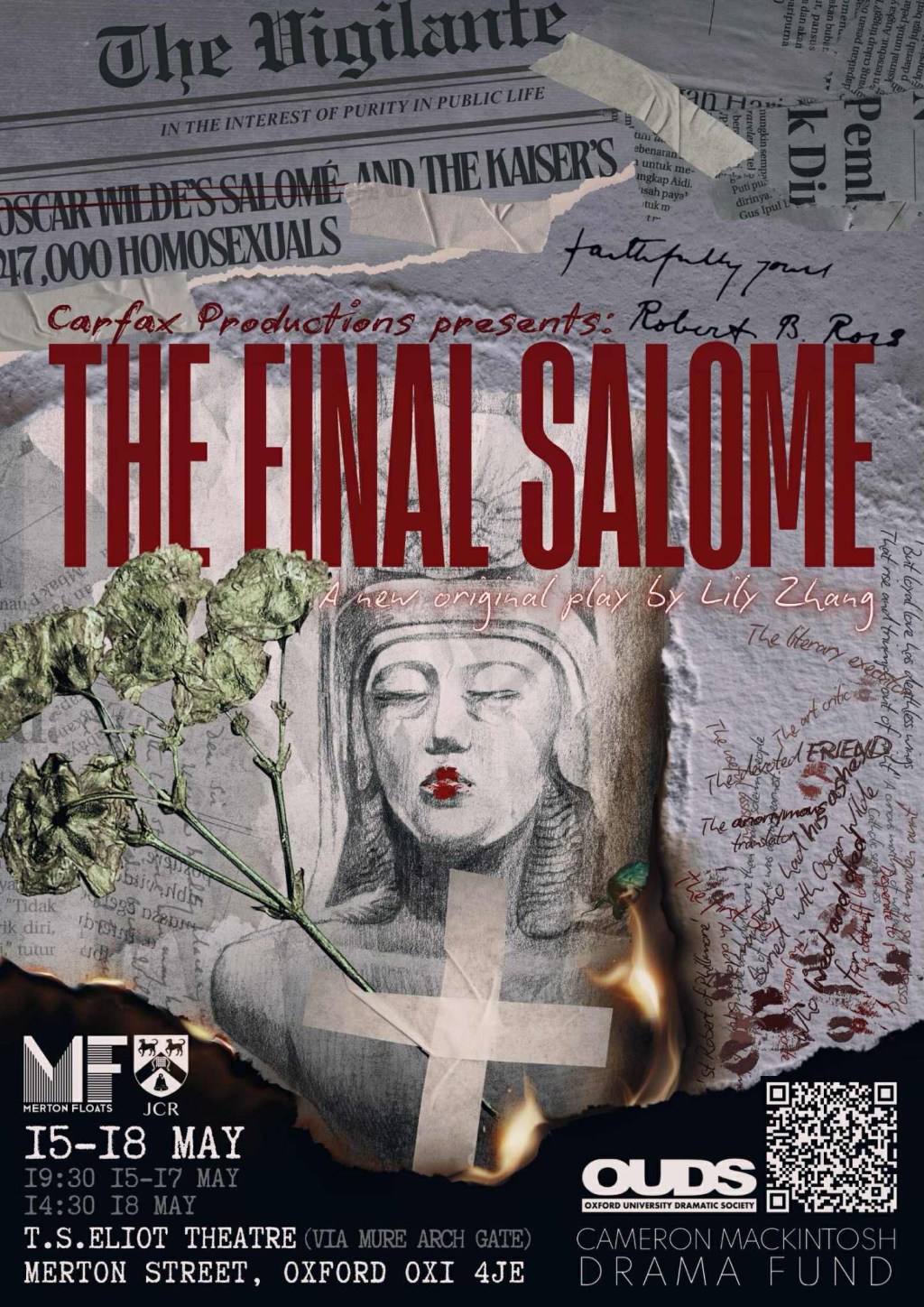
    I must confess that Lily Zhang’s Final Salomé1 has had the misfortune of my intimate involvement – observation or interference, depending on the perspective – in its creative process. The reader should hence understand that while my review is enriched with my knowledge of the play and its context, it will also necessarily be somewhat speculative about what an ordinary audience may experience. 

    The Play [Spoiler Alert]

    The Final Salomé is an impressively well-researched and fresh, modern account of the life of Robbie Ross, Oscar Wilde’s forgotten literary executor and first male lover. It distances itself from the previous accounts, where Robbie is depicted mostly in his professional capacities and/or as a “devoted friend” of Oscar Wilde’s, conveniently keeping his homosexuality under wraps. Instead, the Final Salomé presents a refreshing image of Robbie not just as the friend and literary executor, not just as protector of poets and literary critic, but as Oscar Wilde’s lover and cross-bearer. 

    Structurally, Act 1 starts with the big themes: the political persecution and social marginalisation of homosexuals in Victorian England, exacerbated by the turmoil of the Great War. After the introduction of More Adey (Nikolas Nargi), our unreliable narrator, the audience is precipitated into the ridiculous and hilarious trial opposing protofascist MP Noel Pemberton-Billing (Charlie Lewis) and artist Maud Allan (Saffy Hills), whom the former accuses of turning politicians’ wives lesbian in service of the Kaiser with her performance of Salomé. The story then unfolds around whether Robbie Ross (Peregrine Neger), Oscar Wilde’s literary executor and expert of his work, should testify in defence of Salomé. Yet as the story progresses and as we learn more about Robbie through his flashbacks and his repeated rejection of speaking out in defence of Salomé, one gradually sees that the heart of the play is not, in fact, politics. The elephant in the room is carefully concealed by the shadow of politics, just like Robbie was concealed by the epithet ‘loyal friend’ in his own biographies.

    Act 2 then dissects Robbie’s silence to reveal the complexities of his character. It replays the events of Act 1 from Robbie’s perspective, showing his struggles, complexities, contradictions, and his deepest convictions —— why did he ardently defend Wilde’s work, doing everything to protect Wilde’s legacies, going as far as producing whole new translations of Salomé; why did he ultimately refused to testify to protect Wilde’s legacy, and, by doing so, tragically devastating that very legacy; and why did he direct his ashes to be buried with Wilde in Père Lachaise? ‘Love only should one consider’ was the answer. 

    I have, since the beginning of the creative process, been terrified by how well researched Lily Zhang’s Final Salomé was. This is shown by how many lines are direct quotes from primary sources. Notwithstanding, the play employs an incredibly well-thought-out structure that seamlessly incorporates the necessary information without falling into the common trap of didacticism. I appreciated its abstractness: Zhang ingeniously reordered elements of Robbie’s biography to abstract away from the concrete historical timeline while concretising the abstract ideas of Zhang’s interpretation of who Robbie was.

    Robbie is certainly not an easy person to depict. He is so complex and contradictory: he was self-erasing but egocentric in his own way, brave but weak in his own way, a fighter for queer liberation psychologically imprisoned by internalised homophobia. I particularly appreciated that Zhang made sure he was not erased more than he might have wanted himself to be. Oscar Wilde was not depicted —— a conscious and correct choice. The play also did not claim a full or accurate depiction of his complex character but only showed the blurry memories of More Adey in an asylum, a classic unreliable narrator. The natural mise en abîme between the narrator and narrated is reminiscent of Tim Price’s Nye. Additionally, Zhang employed a constant and very rich stream of symbolisms (like the green carnations) to distinguish imagined characters from their real life counterparts, which not only blurred the line between imagination and reality but also gave an almost psychoanalytic view of the characters (especially Robbie). 

    Under Zhang’s plume, the idea of Robbie is divided into a symmetric pair of abstractions: young and old Robbie. This is quite a brilliant idea: young Robbie (Ren Antoine) was lively, loving, sexual and, above all, has a sense of self; whereas old Robbie was jaded, repressed (and oppressed), and aggressively self-erasing. The production showcased Robbie’s self-erasure, but through his devotion to Oscar Wilde throughout Act 2, one also saw his talent and latent ego when they are channeled into his love for Wilde and poured into Wilde’s work. This contradiction underpinned Robbie’s complex character. 

    The play follows the psychological journey of the two Robbies. We see Robbie tormented by the oppressive society through the numerous flashbacks to his childhood traumas and the persecution he endured in and out of court, but also, more importantly, by the memories of Oscar Wilde. For instance, in one scene, in a rather biblical fashion, old Robbie kills young Robbie, who then resurrects, seduces him with an apple like he thinks he seduced Oscar Wilde, falls into the trap of love with the Majestic Beacon, only to be killed again by old Robbie in despair. The biblical imagery is present throughout the play, not only hinting at Robbie’s Catholicism but also pointing out his sacrificial spirit: always he acted as if in repentance of the ‘original sin’ —- that of ‘corrupting’ Oscar Wilde by introducing him to homosexuality. The biblical elements add a lot of weight to the tragic and cathartic final scene, where Robbie directs his body to be cremated, guaranteeing his place in hell. This made the said scene an absolute masterpiece, and it is difficult to articulate its ardent romanticism with words. I remember crying every time I read or saw it. 

    The other characters are no less colourful. Apart from the complex Robbie Ross, one remembers Lord Alfred ‘Bosie’ Douglas (Sebastian Cynn), whom I’ll shortly return to; Maud Allan, the embodiment of the play’s political elements and the artist behind Salomé —- an ardent defender of her art martyred by her defiance of authority and oppression; More Adey, unreliable narrator but also Robbie’s long term partner, who was always there for Robbie even when he was baffled by him; Olive (Annabelle Higgins), Bosie’s lesbian wife who ‘tried to cure him’, whose subsidiary position to Bosie is analogous of Adey’s…… There is a true plethora of queer characters, each oppressed, repressed, and complex in their own ways, each given a worthy part in the historical fabric that the play tries to weave, and all intertwined by the symmetries that Zhang tries to build through techniques such as deliberate multi-roling. 

    In particular, we see Bosie, the other more famous ex-lover of Wilde’s, as the dark mirror of Robbie Ross. Both were tormented by internalised homophobia, traumatic experiences related to Wilde, and (albeit in different ways) egocentrism; yet whilst Robbie directed his hatred inwards, Bosie projected outward towards the ghost of Oscar Wilde. This was perhaps understandable given how pivotal a role he played (and was seen to play) in Wilde’s downfall. Therefore, after the Wilde trial, Bosie tried to rescue his reputation and cleanse himself of shame by marrying Olive, having a child, and relentlessly suing anyone who brought up his association with Wilde (including Robbie), in order to convince himself and everyone else that he had ‘cured’ himself of homosexuality. Despite this, in the play, Bosie is not depicted as a simple ‘villain’: rather than pitting him against Robbie, Zhang decided to highlight the symmetry. Thus, we see Robbie and Bosie continuously haunting each other throughout the play, with neither really understanding the other. The quid pro quo was most obvious in an elegantly structured scene where Robbie confronted Bosie who just gave a devastating testimony against Salomé that backfired spectacularly and resulted in his own public shaming, which made clear that the two are, in fact, different sides of the very same coin as victims of systematic persecution and marginalisation (and, arguably, also of Oscar Wilde’s lust). 

    The Production

    When reading Lily Zhang’s final draft, I was struck by the elegance of its structure and the beautiful writing of certain scenes. This is perhaps why I was underwhelmed the first time I saw the production, surprised by all the imperfections I had not picked up in the script. This is not to say that the production was not good: as I shall detail in the second part of this review, it was actually remarkable —– the cast and the crew pulled off what could be said to be one of the most impressive student productions I’ve seen in my four Oxbridge years in a small lecture theatre with a wide but shallow stage. Therefore, I was laughing and crying every moment during my second watch, but during the first night, I couldn’t help but be distracted by its flaws. 

    The structure of the play largely worked well. The progression from Act 1 to Act 2 was good, and I did appreciate how Act 2 replayed Act 1 by contextualising and clarifying some of its confusing elements. The double plays, parallelisms, and mises en abîme were on point. I especially appreciated the moments where the different symmetries were made explicit, like when Bosie brought his imaginary young Robbie to court. Additionally, the asylum was well used at the beginning and the end of both acts to give an overall narrative structure to the play. However, admittedly, a trade-off had to be made: the asylum grounded the structure of the play by giving it an essay-like introduction and conclusion, but at the same time, it removed the potential for alternative dramatic effects obtainable by ending the two acts at more important points of the story. 

    The staging was honestly impressively done. In a lecture theatre that had barely any stage depth and several unmoveable objects (including a podium and a grand piano), the crew really made it work using relatively simple props and minimal modification of the stage itself. Here are a few elements. The width of the stage was well exploited, compensating for its lack of depth, through different configurations of four wooden boxes: when stacked together, they become the lawyers’ podiums in the courtroom, and when unstacked, they are bookshelves in Robbie’s home. To further compensate for the lack of space, the crew also uses the entire available space in the lecture theatre; the audience sees Bosie and the ensemble walking down the aisles, Robbie running around the theatre, exiting from one door and entering from another. The lighting also helped build up the atmosphere at multiple occasions: the dim lights used for scenes in Robbie’s memories, the eerie cold lights in the mental asylum, the strong lights focused on Robbie who was questioned about his sexuality, the surreal purple lights when Allan presented her vision of Salomé were all very adequate. The small items and the costumes were simple but exquisite: they had the flavour of Victorian England but were not excessive in the manners of Victorian theatre. Moreover, they carried significant symbolic weight (e.g.: the green carnations). I did also appreciate the ample references to both Strauss’ and Wilde’s Salomé in the script, the set, and the sound, despite imperfect sound quality. 

    I was worried that acting might be a bottleneck to the quality of the production given the play’s complexity. I have to say that my fears were wholly laid to rest. I was blown away by Peregrine Neger’s performance, which, I have to say, really took the show to another level. He truly breathed life into old Robbie in a way that corresponds well to the image I had formed of Robbie when reading the script and discussing it with Lily Zhang. His performance compellingly captured both the lightness of Robbie’s façade and the depth of his internal struggles —- it was definitely at the level of a seasoned professional actor. He also demonstrated his linguistic skills in the scene where he had to read several letters in completely different languages. But these paled in comparison with the penultimate scene, where Neger’s acting talent really blazed through with impressive effect. The rich emotions in his lines delivery, his trembling hands, his tears and his smile of relief when reading Robbie’s final letter was incredibly moving and truly unforgettable. I can only describe his performance using Horace’s words: si vis me flere, dolendum est primum ipsi tibi. That particular scene, and the show in general, was complemented by Ren Antoine’s solid performance as young Robbie. Most memorable was how expertly he handled the very erotic scene, where he forcefully feeds old Robbie an apple. Sebastian Cynn showed the expected amount of hysteria and self-importance when incarnating Bosie. The emotional explosions were quite impressive, and the transitions between different versions of Bosie (imagined/actual) were convincing. I also particularly liked his double-roling as the official receiver, which was absolutely hilarious. If I were to nitpick, I have to admit that I found Bosie a bit too loud sometimes —- therefore, some of his crucial lines, such as ‘Do you think I care for his affection’ in the confrontation scene with Robbie, were not well articulated. Saffy Hills’ Maud Allan had the opposite issue: she delivered a convincing and passionate performance of the artist but sometimes lacked projection. The clown characters —- Pemberton-Billing, Humphreys (Lily Zhang) and the judge (Annabelle Higgins) —- delivered exactly what they set out to deliver: a nonsensical protofascist, an almost-cartoonish caricature of an incompetent lawyer, and a conservative Victorian judge. I have to commend Zhang’s performance as Humphreys for showing her great potential for a legal career; the same could not be said for her Vyvyan Holland, whose interaction with Robbie was rather awkward and exposed her inability to be an affectionate son. There was very little to reproach on all the other characters. 

    This is not to say that I did not have any complaints. 

    In Act 1, my biggest issue is that it focused too much on how others saw Robbie, which made Robbie’s own character rather flat and the structure more repetitive than it should be. This was a surprising discovery I made while watching the play, for I had the opposite feeling when reading the script. Act 1 as it currently stands intersperses Robbie’s traumatic memories with three successive dialogues with Maud Allan, More Adey, and Vyvyan Holland & the Movement, where they try to get him to defend Salomé. While the structure repeats, the scenes were not meant to be repetitive but were rather intended to peel away layers of Robbie’s excuses. However, when watching the show, I found Act 1 rather unproductively repetitive. I conjecture two reasons for this feeling. Firstly, the layers were unclear, because the progression was considerably watered down by the length of the dialogues and the indirectness of Robbie’s lines. Secondly, and arguably more importantly, even if the layers were clearly conveyed and properly understood, they would not have been sufficient to make the audience feel like they were making any progress in understanding Robbie. I remember feeling quite frustrated because while a lot of information was provided during Act 1, they seemed disconnected, shallow, and, above all, unhelpful in bettering my understanding of Robbie. My impression was that immediately following every flashback, Robbie would give the shallowest possible reason for not testifying that can be logically deducted with minimal information about his experience: if he was persecuted in a previous flashback, he would immediately say that ‘they won’t listen’; if he was lynched by Bosie in court, it would be implied in the next scene that he is refusing because of fear for Bosie. It was not immediate that these were excuses and partial truths, that he was showing a façade, or that he had any complexity beyond the surface. I think this was a missed opportunity. Admittedly, the illusion of shallowness could have been intentional, or even historically accurate from his letters. Nevertheless, I maintain that the play might benefit from a stab at Robbie’s real fears (or at least some fragments of his deepest anxieties) in Act 1.

    I must admit that Act 1 flowed much better than I expected (and much better compared to Act 2) thanks to the wit in its lines, the smoothness of its transitions, and the effective use of props and the space. One could argue, however, that sometimes the wit, when inserted amidst serious conversations, could be distracting —- although I did not find it too excessive. For instance, I did think that Bosie’s loud interventions could be made less frequent, less because of the wit and more because of the interruption. My biggest concern is, however, with the scene in Act 2 where Robbie fights everyone to defend Oscar Wilde’s estate. It is an important scene which shows Robbie’s convictions and his hard work, clearly inspired by BBC’s Yes Prime Minister. I would argue however that it is excessively long and unnecessarily repetitive. Moreover, in the show, sometimes comprehensibility was compromised for dramatic effect: the intervention by André Gide with the artificial and incomprehensible French2 accent stood out as an example. Perhaps the first time where Robbie snaps and screams ‘now what’ was a good moment to cut the cycle short and show some actual progress. 

    Like some parts of Act 1, Act 2 also suffered from dialogues that lacked the depth that the situation warranted. When Robbie saw Bosie testifying in the Allan v Pemberton-Billing case, for instance, his reactions were somewhat lacking in depth and gravity: he seemed lightly disappointed by his miscalculation, and much of the disappointment was directed outwards towards Bosie; however, I think Robbie would have been more disappointed at himself than disillusioned with Bosie, and would have engaged in some sort of self-flagellation over his own absurdity (and naïveté) in trying to make a nonexistent pact with an imaginary Bosie. This was more of a writing problem than an acting problem, for the lines hinted at the former when they really should be aiming for the latter. The subsequent confrontation was also a missed opportunity for adding more layers to the Bosie-Robbie duo: Robbie came out of it fully triumphant, but to me, it should not have such a cathartic resolution because the confrontation should have been a rather tragic instance where two deeply-hurt and similarly-tragic men stab each other emotionally where it hurt the most in a winnerless duel. Moreover, because they mirror one another, every stab at the other should also cause an equal part of bleeding in oneself, so this scene should not only showcase how pathetic Bosie was, but also Robbie’s insecurities, weaknesses, and imperfections.

    Finally, there were also facts, contexts or abstractions which should be made more explicit. For instance, it was unclear to me whether the green carnation was sufficient for the audience to understand the distinction between imagined and real characters. This might be unfair: after all, I am speculating on the experience of the average reasonable member of the audience, of which I certainly am not one. What I did find unclear, however, is the fact that Robbie was imagining himself making a deal with Bosie right before the scene of Bosie’s testimony, for it was not very explicitly presented as so.  

    I do want to stress that these criticisms are quite nitpicky and by no means undermine the integral prowess of the writing and the production of the Final Salomé. It is difficult not to be impressed by such a well-rounded student production, and even more so when one learns that this is Lily Zhang’s first ever play. 
    1. The Final Salomé is Lily Zhang’s original new play, produced for the first time at the T. S. Eliot theatre of Merton College, Oxford, between 15 and 18 May 2025. ↩︎
    2. I am French and it was not what a real French accent would sound like. Rather, it sounded like a language enthusiast’s phonological exercise. ↩︎
  • Blood Wedding: Musicality Giveth, and Musicality Taketh Away

    Blood Wedding: Musicality Giveth, and Musicality Taketh Away

    3.5/5

    For most directors of symbolist plays, one of the first big creative decisions they have to make is perhaps how much realism they will imbue the piece with, since some realism is usually necessary to make the performance convincing, yet too much realism spoils the power of the writing. Directors in this country working with translated continental plays are particularly afflicted by this predicament, not least because the symbolist tradition always seemed a bit foreign to English theatre. Recent adaptations (and sometimes re-writings) of Lorca were a case in point: faced with the dilemma, some decided to circumvent the symbolist elements by transplanting the story to modern-day England, giving names to the archetypal characters, and swapping the stunning lyricism for lines that are plain, realist, and down-to-earth (but not quite poetically-earthy). 

    Personally, I am glad that the translator/director (Emma Nihill Alcorta) of this production did not take that easy way out but rather leaned into the musicality of the text. The beauty and the power of the original was properly conveyed to the audience and could be heartily felt by those who do not speak a word of Spanish such as myself. This alone was an impressive achievement. Moreover, to me it felt like Alcorta really believed in the translatability of poetry across time, cultures, and even language barriers, and had faith in her audience’s ability to appreciate poetry. Therefore, she took the risk of preserving more of the original than many other contemporary English adaptations. That gamble, I think, has largely paid off, and on the whole, Alcorta has done the original text justice. 

    However, the greatest weakness of this production also lies with its musicality. The creative team behind it clearly had an ear for music, and the flamenco-inspired original score by Elsa Vass-de-Zomba would have been a solid stand-alone piece, but the overlaying of music over much of the play was rather distracting, not least because it took something away from the lyricism of the lines themselves. To me, the best moments of the show were those when the music came to a sudden halt, less because the silence upped the stakes than because it allowed the poetry to shine through. Additionally, sometimes the carnivalesque quality of the music and the choreography did not mix too well with the Englishness in the acting, and the switching between English and Spanish was slightly disruptive of the rhythm of the play. Admittedly, some of the discordance could be blamed on technical issues: the tuning seemed a bit off during the first half of the show I went to, and the integration of music was significantly better in the second half. Therefore, perhaps the idea simply needs some fine-tuning to bring out its full potential.

    That being said, the actors gave an outstanding rendition of the songs. Everyone who had a singing part clearly had a singing voice. In particular, the Maid (Rebekah Devlin) was clearly a seasoned singer, and the Moon (Lucía Mayorga)’s marvellously ethereal singing voice gave life to the lifeless symbol. Mayorga’s performance was equally convincing. Her haunting eyes’ intensity had an unique stillness, and she wielded the moments of silence like magic. The exquisite embodiment of symbolist poetry sent chills down my spine in the best way possible. 

    On the whole, the cast was really strong for a student production. The fight between the Bridegroom (Gilon Fox) and Leonardo (Gillies MacDonald) was expertly choreographed. The Bride (Thalia Kermisch) struck a good balance between the yearning for life and the longing for death by showcasing both fortitude and vulnerability. And the Wife (Francesca Knoop) effectively brought the full cycle of violence back together in the end by showing how women become jaded after outliving tragedies. The Mother (Siena Jackson-Wolfe), however, had some potential for improvement: the delivery of the lines was sometimes too rigid, and her elegant composure sometimes resembled an Oxford tutor more than a jaded old woman in rural Spain  bound to the earth, the hearth, and the tragedy of endless natality and mortality. To her credit, however, this could be due to anxiety caused by the technical issues which disrupted the opening, which she, together with the other actors, coped very well.

    (Blood Wedding is a play by Federico García Lorca. It was translated by Emma Nihill Alcorta and produced at the Oxford Playhouse between 4 and 7 June 2025.)

  • Patience: “Just like a good English Breakfast”

    Patience: “Just like a good English Breakfast”

    2.5/5

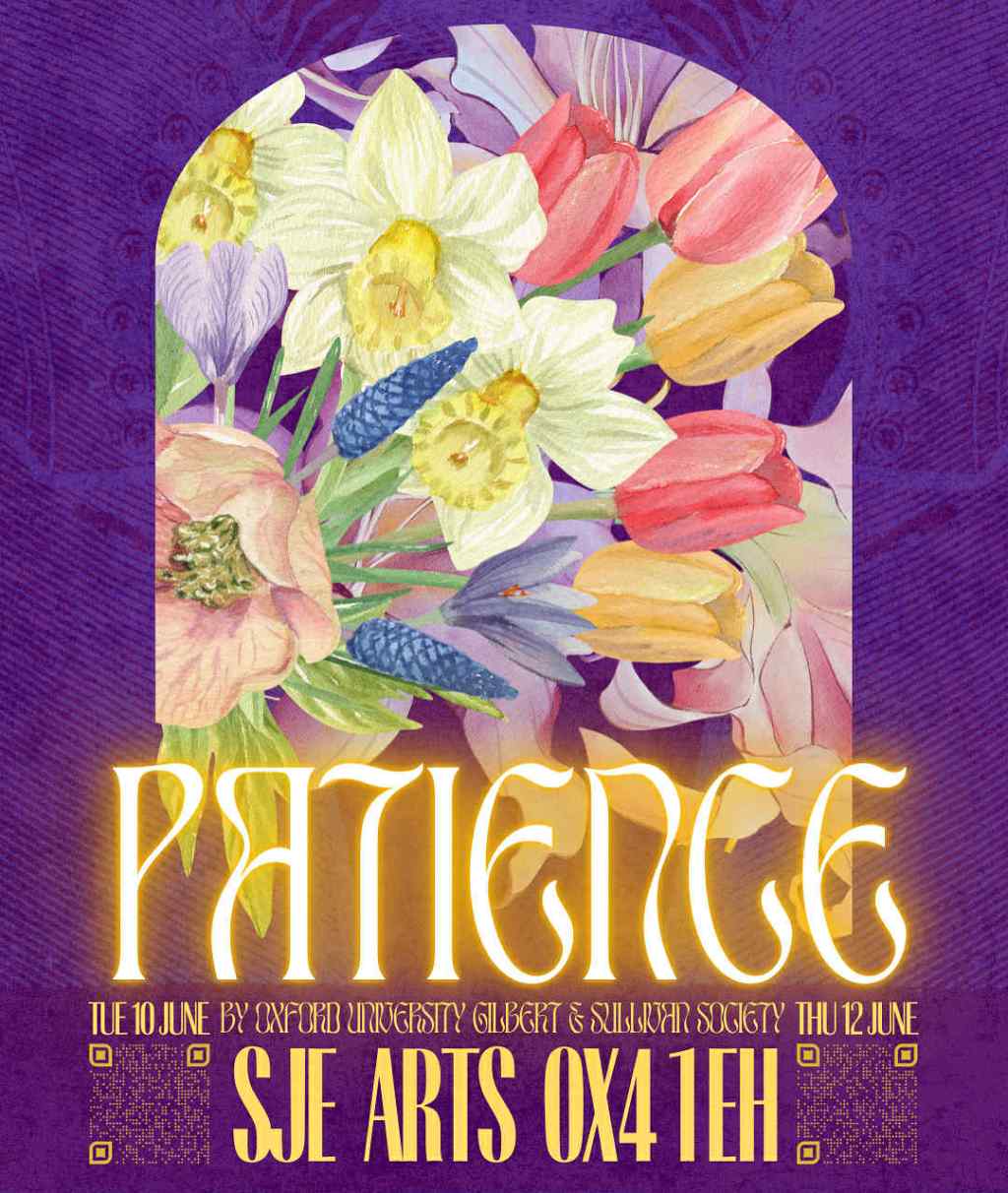
    The Oxford Gilbert and Sullivan Society’s production of Patience was a very good rendering of the satirical opera of the aesthetes, which plays with Victorian sensibility towards mediocre poetry in a way that reminds me of Molière’s Précieuses Ridicules

    Modulo prop mishaps like a shattered mirror (Bunthrone managed to recover from, to his credit), the mise en scène did everything that was necessary. The chapel space was effectively utilised by the decor, the paper flowers were beautiful with a subtle Victorian air, and the props (even when they were breaking) were very ‘aesthetic’ (and I use this word advisedly). 

    In terms of the performance itself, the rendering of the comedy was properly (and almost stereotypically) English, with, of course, the exquisite performance of Bunthrone (Peregrine Neger), whose eminently expressive face and physicality made certain scenes genuinely hilarious. (In fact, their improvised response to the broken mirror was so funny that a small, sadistic part in me almost wished that every performance would have some sort of accident which allows their talent to shine through under pressure). This was complemented by the likewise hilarious rendering of Grosvenor (Phoenix Solti) and Patience (Eleanor Worth), whose ad-libs were admirable and clearly proved them both as seasoned actors. The orchestra was clearly very well prepared, despite certain small hiccups. The lighting was the cherry on top, adding extra comical effects at just the right moments. Finally, I appreciated the occasional addition of some more modern elements —- such as the maiden’s life drawings of Bunthorne, the English football team jersey (instead of the more traditional army uniform), the moonlighting (or rather almost sunlighting) lesbianism within a select subset of maidens. 

    Overall, it is difficult to criticise such a cliché English operette. Discounting the inherent challenges of opera (in terms of both singing and music), there wasn’t much left to critique in terms of acting and staging, for most characters seem to be variations of classic comedic stereotypes. That said, one must not discount how the performance made all these soi-disant “simple” things seem effortless. It takes skill to play clichés well —- and the skill is clearly one that both the cast and the crew possessed. 

    In my humble opinion, the production is like a good English breakfast: simple, with most ingredients pre-prepared and canonically English —- traditional, predictable, and exactly as one would expect —- yet frightfully well-executed and delightful with a pinch of additional modern spice.  What more is there to ask?

    (Patience was written by Gilbert and Sullivan, produced by the Oxford G&S society on 10 and 12 June 2025 at the SJE Chapel.)