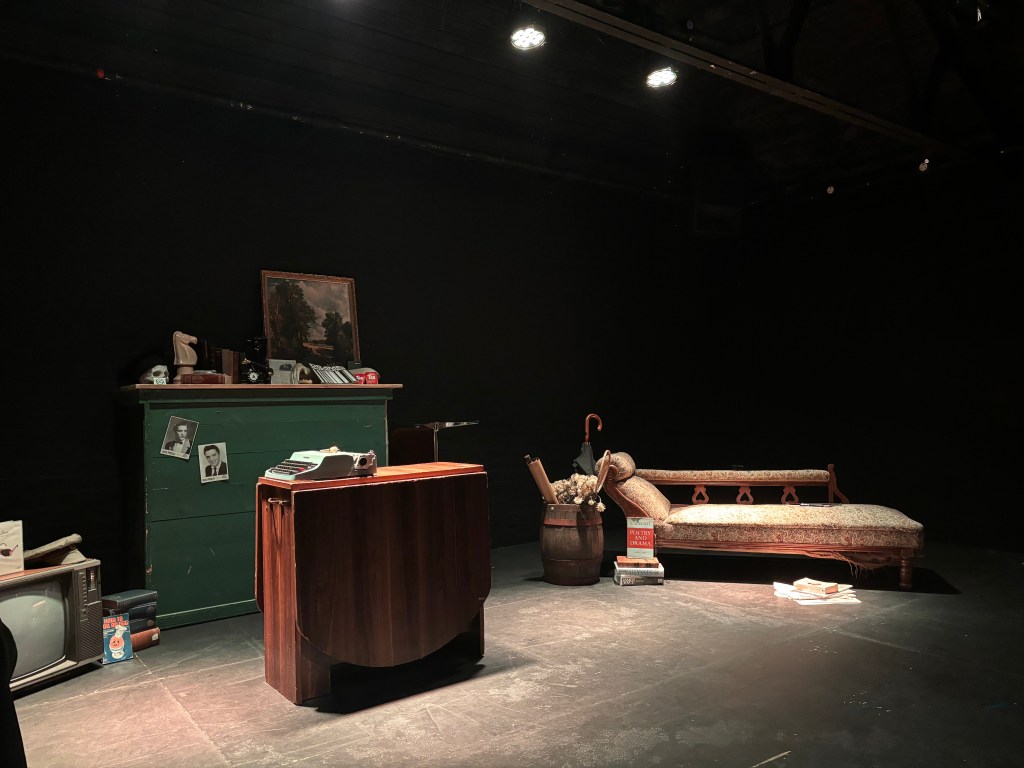
2.5-3/5
‘I do not know whether there is anything peculiarly exciting in the air of this particular part of Oxfordshire, but the number of theatrical suicides that take place seems to me considerably above the proper average that statistics have laid down for our guidance.’
I confess I have not written reviews in some time — life got in the way (as it tends to do), and the few productions I managed to see (with the exception of a musical) proved less thought-provoking than my company law textbook, rendering review-writing an utterly futile exercise. This somewhat harsh review comes not from a place of contempt — quite the opposite, in fact. This is the first time in months that I feel positively compelled to write a review, for To What End was considerably more stimulating than most new writings I had seen in London. The severity in the paragraphs to come stems rather from a peculiar form of self-reflection (which some may call self-hatred): when one sees in another’s work some fault which reminds one of the many issues in one’s own writing, a certain harshness (which is sometimes excessive) creeps in, born of that particular ruthlessness we reserve for our own failings, which prompts one to go a bit overboard in one’s criticism. My empathy, therefore, may prove a curse for this review.
I must begin by praising the play’s ambition. Indeed, the title itself reflects the writers’ literary (if not philosophical) aspirations, and the writing shows genuine intellectual edge — a quality rare enough in much of contemporary theatre, rarer still in student writing. The structure played with repetition and circularity, and with each cycle the play became more ‘meta’, as the characters were wont to say, compelling the audience to muse on relationships between the writer and the director, the performer and the observer, etc etc. On the whole, the writing had an elusive but roguish charm which flirted with French absurdism, whilst the lines were peppered with English wit — an ambitious (albeit dangerous) Anglo-French hybrid.
Curiously, however, I was under the impression that the play was split in two halves by a death like Camus’ The Stranger (I thought that was where ‘Albert’ came from). Up until the first murder-suicide, there was careful character development: a pair of actors with evident personal history played a wartime German-English couple; at the same time, we caught glimpses of complex feelings between the two directors, Bernard and Albert. The dialogue sparkled with wit, and the characters were gradually gaining weight (figuratively, of course). With the first murder-suicide, however, everything fell apart — for the characters and the play alike. The directors became actors, the actors became directors, and a trial scene unfolded where the director and the judge repeated lines in an endless loop. Before the first murder-suicide, the dialogues had subtle grace and felt like a riddle leading somewhere. Afterwards, when everything began to spiral, the lines crumbled under the weight of the ‘meta’ absurdism the writers wished to convey. What began as measured absurdism devolved into something that felt like circularity for circularity’s sake — almost like a bad English parody of French absurdist theatre.
I would venture that the crux of the issue is that in absurdist theatre, whilst the text can be meaningless, characters cannot be aimless.
In the production I watched, I often couldn’t distinguish between performance and reality — which, admittedly, was conceptually very clever, but when one really could not tell whether someone was pretending to be a second-rate actor, the conceptual cleverness of the writing inevitably fell flat on an audience too confused to appreciate the philosophical nuance. Peregrine Neger, who was playing Albert, almost succeeded in conveying all the layers of (un)reality and doing justice to the writers’ ambitions. Sadly, the burden proved too heavy for a single set of shoulders. In particular, Bernard, played by Tomasz Hearfield, was in such a consistent state of nicotine-fuelled anxious confusion which transcended, and therefore defeated, all attempts at layering realities. Perhaps in an ideal world where there were more chemistry between Albert and Bernard, there would have been less confusing absurdity and more genuine absurdism. But it wasn’t just Bernard. I dare say that beyond Albert (and perhaps The Tape), most characters lacked a consistent aim. The Husband and Wife were like a pair of colourful cutouts, whilst the judge and the detectives were like grey shadows lurking in the corner, but their insularity and one-dimensionality were not quite by design. Often, therefore, Albert appeared stranded whilst Bernard wandered off and other characters mushroomed around them. In the absence of effective interactions, the tensions that had built up in the first part inevitably deflated. Even Albert occasionally lost his edge, becoming something like a stock art critic character. For the play as a whole, the consequence is that the outbursts often felt abrupt and groundless, leaving the suicides that followed in an uncomfortable middle ground — too light to warrant emotional responses but too heavy to achieve absurdity. In the end, the yield of the above-average theatrical suicide count was sadly below-average. I could not even ascertain whether it was a comedy or a tragedy — and not quite in a meta way.
Fundamentally, that was a writing problem rather than an acting one. The characters beyond Albert and Bernard had limited material to work with. Not that they had no stage time, but that their lines often felt like fillers without much potential for character-building or dramatic tension, and it wasn’t clear what individual characters were trying to achieve during their time on stage. I posit this was because the writers did not know exactly why they were asking ‘to what end’ in the first place. What exactly prompted the inquiry? Why are quests for meaning futile? What answers have been given and why were they all inadequate? In the absence of answers to these questions, the absurdism lacked substance, and the lack of a philosophical dimension translated into minimal depth for most minor characters. The interview and the court scenes, for instance, felt a bit pointless — not in the productive, absurdist sense, but in the deflating sense that one suspects the writers simply didn’t know what to do with them. It seemed like the minor characters existed solely to serve Bernard and Albert, who were, for reasons stated above, often none the wiser.
To be sure, characters can of course question ‘to what end’ their existence serves, but a character that does (or worse, is) little else rarely sways an audience. Personally, there are two things I learnt the hard way and am still grappling with. Firstly, characters audiences care about are usually built from intentions rather than historical facts (or, worse, philosophical ambitions). Secondly, audiences dislike being addressed through obscure symbolisms that exist purely for the writer’s satisfaction. An outstanding actor might be able to hide or compensate for such problems by inventing intentions within the constraints they are given, essentially completing the character work and elevating the play. However, that is an enormous ask of student actors working with limited rehearsal time and still developing their craft.
Similarly, plays can pose very meta questions about meanings or purposes, as indeed many French absurdist plays have done. However, to be properly French, one must first master the art of French essay-writing to some extent: the age-old framework of thesis-antithesis-synthesis may seem rigid and archaic, but it remains instructive. Absurdism and metatheatricality without dialectical progress deprive a play of actions and make philosophical musings seem like a whole lot of hot air. Arguably, to reach genuine absurdity, one must either begin with something concrete and watch it inevitably collapse under the weight of existential conditions like Ionesco, or imbue every element with absurdity and dive into more layers as the play progresses, like Beckett. Whilst I do not profess to be the expert on absurdism and there are certainly exceptions to the general rule, I dare say that hitting the audience square in the face with circularity without dialectical progression and expecting the audience to immediately grasp the writer’s genius is asking for a bit too much. In short, taking a sledgehammer to ‘meaning’ without establishing what that meaning might be risks missing the point of iconoclasm — one may end up with absurdity without absurdism. It brings to mind the humanities undergraduate encountering Derrida far too early in their career and embraces deconstruction before learning to be constructive.
Fortunately, character-building and philosophical exploration work best in tandem, and the writers have already laid very solid groundwork. Their intelligence is evident throughout. I dare suggest two adjustments that may help do their ambition justice. First, grounding abstract ideas in concrete character motivations. Albert and Bernard are already well-written characters possessing genuine charm, distinct personalities, and interpersonal chemistry. A bit more clarity on Bernard’s writerly angst would help considerably with landing the absurdism. To this end, the writers might consider channelling more of their own philosophical frustrations about meanings in theatre. And if each minor character can be given a clearer philosophical as well as personal purpose, the spirals may clear up a great deal. Secondly, be careful with repetitions. As someone often guilty of wanton repetition, repetitions seldom work as well on stage as they do in the writer’s imagination. Better to let characters speak as characters rather than anchoring the play on repetitions — not that repetitions never work, but indulging in repetitions can spoil a play. Admittedly, however, it is much easier to talk the talk than walk the walk. Abstract ideas are clean and elegant, whilst human intention is like a lamprey — slippery, slimy, and altogether disgusting to handle.
Despite all these quibbles, I enjoyed the production. I had a good laugh, loved the ideas behind it, left the theatre thinking about it, and did not stop thinking about it till 3am the next morning. The writers may have bitten off slightly more than they could chew, but that’s hardly a sin. Better to aim for the moon and land among the treetops than never leaving the ground at all.
 Pigeon Post